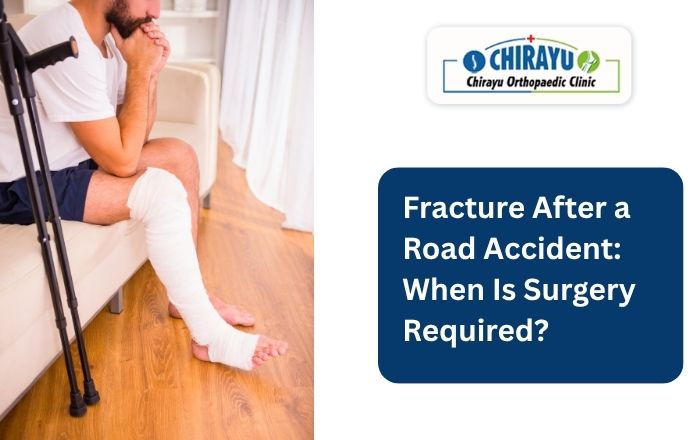
If you or a family member has a fracture after a road accident, one of the first questions is usually: will this need surgery? The honest answer is that it depends. Many broken bones heal well in a plaster cast or brace, while others need an operation to heal in the right position.
What to Do Right After a Road Accident
Safety and early medical care come first.
- Call for help. In India, dial 112 for emergencies or 108 for an ambulance.
- Keep the injured limb still and support it in the position you find it.
- Cover any open wound with a clean cloth, especially if bone is visible.
- Do not try to straighten a deformed arm or leg yourself.
- Avoid food and drink until a doctor has seen you, in case surgery is needed.
Even if the pain seems mild, get checked. Some fractures are missed without an X-ray.
How Doctors Decide Whether a Fracture Needs Surgery
An orthopedic surgeon looks at the whole picture, not just the broken bone. The assessment usually includes:
- A physical examination of the limb, skin, circulation and nerves
- X-rays from more than one angle, and sometimes a CT scan for complex or joint fractures
- Your age, general health, bone strength and daily activity needs
Doctors also check for injuries to the head, chest, abdomen or spine. Read more in our article on what orthopedic trauma means.
Fractures That Can Often Heal Without Surgery
Non-surgical treatment may be suitable when:
- The bone pieces are well aligned (non-displaced)
- The fracture is stable and unlikely to shift
- The skin over the fracture is intact
- The break does not involve a joint surface
Treatment may include a cast, splint, brace or sling, pain relief and follow-up X-rays to make sure the bone stays in place. Sometimes the doctor first realigns the bone without an incision, which is called closed reduction.
When Is Surgery Required After a Road Accident Fracture?
Surgery is usually advised when a bone is unlikely to heal properly, or in the correct position, without it.
Open (Compound) Fractures
In an open fracture, the bone breaks through the skin or is exposed through a wound. Road dirt can enter the wound, so the infection risk is higher. These are emergencies and usually need urgent wound cleaning and stabilisation of the bone.
Displaced or Unstable Fractures
When bone fragments have moved out of line, or are likely to slip inside a cast, surgery holds them in position. Healing in a poor position can affect how the limb works later.
Fractures Involving a Joint
Breaks extending into the knee, ankle, elbow, wrist, hip or shoulder often need precise realignment. An uneven joint surface may lead to stiffness or arthritis over time.
Multiple or Severely Broken Bones
Road accidents can cause comminuted fractures (bone broken into several pieces) or several fractures at once. Surgical fixation may allow earlier movement and easier care.
Nerve, Blood Vessel or Compartment Problems
If a fracture injures nearby nerves or blood vessels, or causes dangerous pressure inside the muscles (compartment syndrome), urgent surgery may be needed.
Fractures That Do Not Heal as Expected
Occasionally, a fracture treated in a cast shifts or heals slowly, and surgery is then considered.
Common Types of Fracture Surgery
The right procedure depends on the bone, the fracture pattern and the patient. Options include:
- Plates and screws: The bone is realigned through an incision and held with metal implants.
- Intramedullary nailing: A metal rod is placed inside long bones such as the thigh bone (femur) or shin bone (tibia).
- External fixator: A frame outside the limb holds the bone steady, often temporarily for open fractures or badly swollen limbs.
- Joint replacement: In selected cases, such as certain hip fractures in older adults.
See how these injuries are managed on our accident and trauma surgery page.
Recovery After Fracture Surgery
Bone healing commonly takes several weeks to a few months. It can be slower with smoking, diabetes, poor nutrition or infection. Your surgeon will guide you based on follow-up X-rays.
Recovery usually involves:
- Wound care and keeping the dressing clean and dry
- Controlling pain and swelling, including keeping the limb raised
- Gradual movement and weight-bearing as advised
- Physiotherapy to restore strength, balance and joint movement
- A balanced diet with enough protein, calcium and vitamin D
Rehab and physiotherapy plays a big part in returning to daily activities. For home tips, see our post-fracture care guide.
Warning Signs After Surgery
Contact your doctor promptly if you notice:
- Increasing pain not controlled by medicines
- Redness, pus, fever or a foul smell from the wound
- Numbness, tingling, or a pale or bluish limb
- Calf pain, chest pain or sudden breathlessness
Frequently Asked Questions
Does every fracture after a road accident need surgery?
No. Many stable, well-aligned fractures heal with a cast, splint or brace. Surgery is generally advised for open, displaced, unstable or joint fractures, or when nerves or blood vessels are affected.
How soon is surgery done after an accident?
Open fractures and injuries affecting blood supply are treated urgently. Other fractures may be operated on within days, once swelling settles and the patient is stable. Your surgeon decides the safest timing.
Will the plates or rods need to be removed?
Often they stay in place without causing problems, but may be removed later if they cause discomfort.
How long before I can walk after leg fracture surgery?
It varies with the bone, the type of fixation and how the fracture is healing. Some patients start partial weight-bearing early with support; others wait longer. Follow your surgeon’s advice.
Is fracture surgery painful?
Surgery is done under anaesthesia, so you will not feel pain during it. Some pain afterwards is expected and is managed with medicines, rest and elevation.
Can a fracture heal in the wrong position without treatment?
Yes. A bone can heal out of alignment (malunion) or fail to heal (non-union) without proper treatment, which is why early assessment matters.
Get Your Fracture Assessed by an Orthopedic Surgeon in Pune
If you have pain, swelling, deformity or difficulty moving a limb after a road accident, do not wait for it to settle on its own. An early examination and X-ray can show whether a cast is enough or surgery is needed.
Dr. Vinil Shinde, MBBS, MS (Orthopaedics), MRCS (UK), is an orthopedic surgeon with more than 20 years of overall medical experience. His areas of work include trauma and fracture management, joint replacement and sports injuries. He consults at:
- Chirayu Clinic, Kothrud/Bavdhan: Swapna Sakar Society, opposite Royal Enfield Showroom, near Chandani Chowk, Kothrud, Pune 411038. Phone: 77200 80890
- Pashan/Sus: Sukhwani Boulevard Commerz, Pashan Sus Road, Sus, Pune 411021. Phone: 72729 10202
- Pimpri Chinchwad: Gera Imperium, near PCMC Metro Station, Morewadi, Pimpri Colony, Chinchwad, Pune 411018. Phone: +91 98903 80890
Call to book a consultation or send an appointment request online. In an emergency, go to the nearest hospital emergency department straight away.